


(Photo Credit: Bill Kind)
by Tucker Terranova
Few motions in sports push the human body like throwing a baseball. Each pitch tears muscle fibers, stretches ligaments to the brink, and twists the arm into unnatural shapes.
For many, this violent motion is the gateway to a dream. Whether it’s a college scholarship, a professional contract, or the chance to call yourself a Major Leaguer, players, especially pitchers, push their bodies to the limit. A few miles per hour on a fastball or a fraction of a spin rate on a slider can be the difference between making it to the next level or not.
In today’s analytical revolution, pitchers have data at their fingertips, making this generation the most advanced yet. However, it’s also led many to chase metrics that college coaches and scouts crave. Combined with an increase in players throwing year-round, pitchers are putting more stress than ever before on their arms.

Along with this has come a surge in Tommy John surgery among youth athletes. The surgery, named after its patient zero, has gained a reputation as the grim rite of passage for pitchers.
Once seen primarily in professional arms tasked with throwing 200 innings over the course of a season, Tommy John surgery, performed to repair a torn Ulnar Collateral Ligament (UCL), has begun to plague young pitchers. The added stress from chasing velocity and exposure has taken a toll on high school arms hoping to climb the ranks of competitive baseball.
LHP Logan Prisco (Newfield 2023) commits to the University of South Carolina. He currently attends Florence-Darlington Tech in SC pic.twitter.com/UfX7TtJKJe
— Axcess Baseball LI (@axcessbaseball) October 19, 2024
For those pursuing a collegiate career, the diagnosis can feel like a death sentence.
“I kind of had a feeling something was off at first, but hearing that I was going to need Tommy John surgery really hit me. That’s when it set in, and I realized how long the timeline to get back on the mound was going to be,” said Logan Prisco.
Prisco, a 2023 graduate of Newfield High School, suffered the injury in June right before his senior season, the prime recruiting period for high school athletes.
“It put my recruitment process in a weird spot. With the injury happening so late, I knew it would complicate things, so I decided to take a post-grad year at Elev8 Baseball Academy to recover and get back on the mound,” Prisco said.

Forced to take an alternative path to college baseball, Prisco quickly learned that the toughest part of recovery wasn’t physical, it was mental. Taking a baseball player away from the game for an entire year is difficult, especially for a high schooler.
But the detour paid off. Shortly after arriving at Elev8, Prisco committed to Florence-Darlington Tech CC in South Carolina, and he’s set to join the University of South Carolina’s baseball team in the fall.
“Be patient. Don’t rush it or compare your progress to anyone else’s. Stick to the process and do as the body feels,” said Prisco. “A lot of people look as the time being out as a negative but you have to use that time to get stronger so when you step on the mound, you’re stronger than you were before.”
Even at the college level, hearing the words “torn UCL” doesn’t get any easier. Every practice from August to Opening Day is a battle for a roster spot, and being sidelined can jeopardize a player’s place on the team.
Seaford RHP Billy Kind fired a perfect game (7 innings) with 5 strikeouts in an 11-0 win over Locust Valley
Nick Apollo hit a grand slam, had 2 singles and drove in 8 runs
Seaford improves to 11-0 pic.twitter.com/x2FhFyI3jQ
— Axcess Baseball LI (@axcessbaseball) April 25, 2023
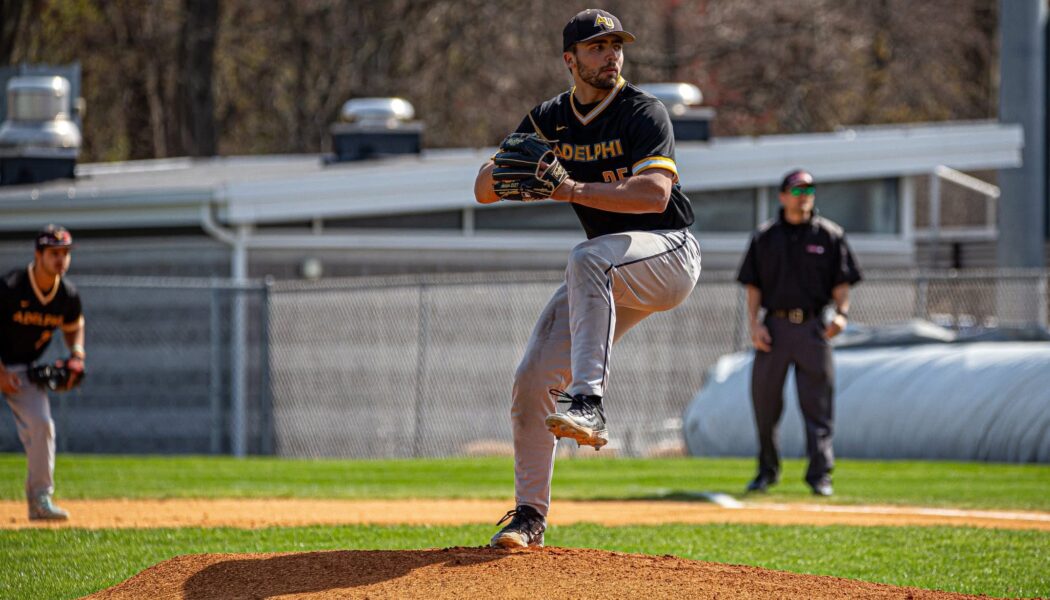
Billy Kind, a sophomore at Adelphi University, received the diagnosis just before what was supposed to be his freshman season.
“When I first got my diagnosis, I kind of figured something was going on with my elbow. But being told I had a torn UCL definitely shocked me. At the time, I’d never had any pain or soreness from pitching, so I didn’t think much of it, just felt like I was gradually becoming less and less like myself on the mound. That’s when I knew something might be wrong,” said the Seaford native.
Kind noted that dealing with the injury in a college setting came with both pros and cons. While the competitive environment of a Division II program can put an injured player at a disadvantage upon return, the access to top-tier treatment made a significant difference.
“I do think there are some positives to dealing with it as a college athlete rather than in high school,” Kind said. “It can be easier for a college athlete to get in with a better surgeon because of school and coach connections. Another big benefit was having a full-time athletic training staff and a full training room. I did go to physical therapy off campus, but my surgeon and PT were both working with Adelphi’s training staff.”

As Tommy John surgery has become more common in recent years, it’s important to note that misconceptions still surround it, one of the biggest being that it’s strictly a pitcher’s injury.
Aidan Annello, a senior at Holy Trinity High School and a corner infielder, is currently recovering from the procedure. He’ll head to Vassar College this fall, but the diagnosis was a shock he never saw coming.
Aidan Annello (Holy Trinity 2025) commits to Vassar College @HTHS_Athletics @NextLevelBaseba pic.twitter.com/fwZRUIgpCS
— Axcess Baseball LI (@axcessbaseball) September 20, 2024
“At first, I was distraught when I heard the diagnosis because it meant I’d have to completely miss my senior season,” Annello said. “I was also a little confused, because I had never had an elbow problem before, the injury just came out of nowhere.”
Annello noted that the recovery process is a 24/7 commitment. Whether it’s trips to physical therapy on Mondays, Wednesdays, and Saturdays, daily band work on his own, or workouts tailored around his injury, he’s constantly putting in the work to be ready for the fall season at Vassar.
A unique part of Annello’s recovery has been his focus on the mental side of the process, which he cited as the hardest challenge so far. To help with that, he’s been working with Brandon Guyer, a seven-year MLB veteran and founder of Major League Mindset (MLM), who also serves as a mental strength coach for the Los Angeles Angels.
“We’ve built a mindset that allows me to truly believe in my recovery and trust that I’ll come back in the best physical and mental shape I’ve ever been in,” Annello said.
The mental side of injury is often overshadowed by the physical, but for athletes to fully recover, the mind has to heal just as much as the body. Tommy John tests these players not just as athletes, but as people.
Aidan Kistner, a senior from Babylon, is currently rehabbing after a misdiagnosis set his recovery back by five months. Kistner is well aware that the mental burden of the injury can be much more than the physical side, noting the importance of keeping spirits high during recovery.
Congratulations to Babylon’s Aidan Kistner who is the recipient of the Axcess Baseball x BK7 Brand Player of the Week. He started and won 2 games, pitching 10 innings without allowing an earned run, striking out 21 batters, yielding just 5 hits. At the plate, he was just as… pic.twitter.com/7uCM6EkkLy
— Axcess Baseball LI (@axcessbaseball) April 7, 2024
“Watching games from the sideline feels like a punishment. There are good days and then there are bad days. During the first two months after surgery I sometimes wondered how I would ever throw a baseball again because of how painful stretching out the new ligament felt,” said Kistner. “I have tried to tell myself every day during recovery to just get 1% closer and to win the day. That has helped get me through.”
That daily grind of recovery is something all four athletes share. It strips you of your joy for the game, forcing you to rekindle your love in new ways, which Kind understands all too well.
“As a player, the injury reminded me how much I love the game of baseball, and pitching specifically,” Kind said. “There was nothing I missed more over the past year than being at the ballpark and taking the mound. I wasn’t going to let the injury derail my college career or end my playing days.”
To stay connected, Kind began coaching a 14U team during his recovery, an experience that gave him a new perspective on the sport he loved.
“It was a great experience because it brought back the competitive aspect of the game, just in a different role,” he said. “I was able to help younger guys grow as players and as people. There were definitely times I felt a little loss of motivation, but staying around the game reminded me why I love it so much and the motivation came right back.”
As these athletes make their return to the diamond, the scars of surgery aren’t just the ones visible along the inside of their elbows. Recovery is a true test of love for the game, a blessing in disguise that forces players to reflect on why they go the extra mile for baseball in the first place.